
Company Name on Glass Doors and Walls, 7 Methods Compared (Which One Lasts Longest)
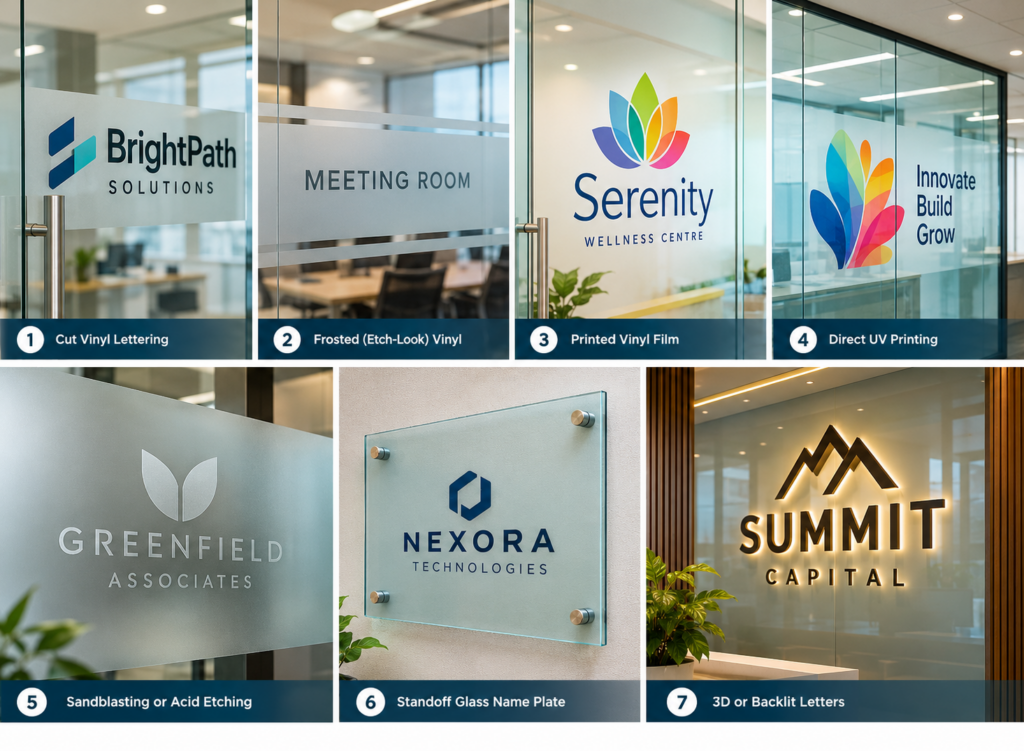
Here’s the short answer. If you want your company name on glass to last as long as the glass itself, choose sandblasting or acid etching. The lettering is cut into the surface, so there’s nothing to peel or fade. Every other method sits on top of the glass, and that’s where wear starts.
“Longest lasting” isn’t always the right brief, though. A startup renting a Salt Lake office for two years doesn’t need permanent etching. A CA firm that has owned its Dalhousie floor for twenty years probably does. Below, we compare the seven methods clients ask us about most on lifespan, looks and what happens when you move out.
How Long Does a Company Name on Glass Usually Last?
Method | Typical indoor lifespan | Removable? | Best for |
Cut vinyl lettering | 5–7 years | Yes | Rented offices, quick rebrands |
Frosted (etch-look) vinyl | 5–8 years | Yes | Cabins, privacy bands |
Printed vinyl film | 3–5 years | Yes | Full-colour logos |
Direct UV printing | 7–10 years | Only with scraping | Colour logos on interior glass |
Sandblasting or acid etching | Life of the glass | No | Owned premises |
Standoff glass name plate | 10+ years | Yes, unscrews | Entrances, cabin doors |
3D or backlit letters | 8–12 years | Yes | Reception feature walls |
These figures are for indoor glass. Any film-based method loses a year or two when the glass faces a street that gets strong afternoon sun.
The 7 Methods, One by One
1. Cut Vinyl Lettering
A plotter cuts your letters from a roll of PVC film, and an installer applies them with a squeegee. It’s the cheapest option and usually ready within a day or two.
There’s a catch most people learn the hard way. Cheap calendered vinyl shrinks over time, so on a door pushed a hundred times a day, the letters nearest the handle start lifting within a year. Cast vinyl costs more and holds its edges far longer, so insist on it.
2. Frosted or Etch-Look Vinyl
This film imitates sandblasted glass at a fraction of the price. It also adds privacy to cabins and meeting rooms, and it works as a safety band so nobody walks into a clear partition.
For a glass name board for office cabins in rented space, this is the method we recommend most often. When the lease ends, it peels off cleanly and leaves no damage.
3. Printed Vinyl Film
When your logo has gradients or more than two colours, plain cut vinyl can’t reproduce it. The design is printed onto white or clear film, laminated, and then contour-cut.
Lamination is the part people skip to save money. Unlaminated prints fade noticeably within two years near a window.
4. Direct UV Printing on Glass
Here, ink goes straight onto the glass and hardens instantly under ultraviolet light, a process called UV curing. You get sharp colour with no visible film edge. Removal takes a blade and solvent, and printing usually happens before the panel is installed.
5. Sandblasting or Acid Etching
Abrasive blasting and glass etching both remove a thin layer of the surface. The result is permanent, which is the method’s biggest strength and its biggest weakness. If you rebrand, the glass has to be replaced.
One technical note matters here. Most office doors use tempered glass, and deep carving should be done before the glass is toughened. Light surface frosting on installed glass is common, but check with your glass supplier first. Honestly, we only suggest this method to businesses that own their premises.
6. Standoff Glass Name Plate
A separate panel is fixed to the wall or door with stainless steel standoffs, and the lettering is printed or etched on the back face so the front stays easy to wipe. This style gives you the most freedom in glass name plate design. You can choose clear, frosted or back-painted glass, in nearly any shape.
If weight is a worry on a gypsum partition, consider acrylic. Many clients who come to us for an acrylic sign board in Kolkata order pick a frosted acrylic standoff panel instead, because it weighs less than half as much as glass of the same size.
7. 3D or Backlit Letters
Raised acrylic or metal letters add depth that flat film can’t match. They’re either fixed directly to the glass or mounted on the wall behind a glass partition, so visitors read the name through it. For lobbies that want a real centrepiece, 3d sculptural signage turns the logo into a standalone object.
Halo and edge-lit effects follow the same principles as any backlit board design, and they keep the name visible after office hours. Lit versions need wiring planned before the partition goes up.
Glass Name Plate Design Tips That Keep It Readable
A good method can still fail with a careless layout. These are the issues we correct most often on site:
- Check what’s behind the glass. White frosted letters disappear against a white wall, so pick a dark film or add a background panel.
- Size letters for viewing distance. A common signage rule is roughly 1 inch of letter height for every 10 feet a reader stands away.
- Keep the main name close to eye level, around 1.5 metres from the floor.
- In Kolkata’s monsoon, air-conditioned glass sweats on the outer face. Film applied to that side can lift, so use the inside face whenever possible.
- Use the logo in vector format (AI, EPS or PDF). A blurry JPEG produces fuzzy cut edges.
Which Method Should You Choose?
A simple rule settles it for most businesses:
- Renting, and you might move within three years? Choose cut or frosted vinyl.
- Own the premises, and the glass won’t change? Choose sandblasting.
- Need an exact colour logo? Choose UV printing or laminated printed film.
- Want the reception to make an impression? Choose 3D or backlit letters, sometimes paired with frosted film on the cabin doors.
Frequently Asked Questions
Can you put a company name on toughened glass?
Yes. Vinyl, printed film and standoff plates all work on toughened glass without any risk. Deep etching should happen before toughening.
What is the cheapest way to put a company name on glass?
Cut vinyl lettering is the cheapest. A single door usually takes under an hour to install.
How do I remove old vinyl letters without scratching the glass?
Warm the letters with a hairdryer, lift them with a plastic scraper, and wipe off the leftover adhesive with isopropyl alcohol. Avoid metal blades on coated or tinted glass.
Does frosted vinyl look like real etching?
From a couple of metres away, most people can’t tell the difference. Up close, you’ll notice the film edge, and real etching feels slightly rough to the touch.
Is a glass name board for office cabins better than acrylic?
Glass feels heavier and more premium, and it resists scratches better. Acrylic is lighter, cheaper and safer on weak partitions. Both look sharp when the lettering is done well.
Getting It Done in Kolkata
Send Shree Shyam Signages a photo of your glass, rough measurements and your logo file. We’ll tell you which method fits your lease, budget and lighting, and we can visit the site to measure before quoting. Most vinyl jobs are installed within the same week.