
Digital Hoarding Advertising vs Printed Flex Hoardings, Which One Actually Pays Off for Your Business?
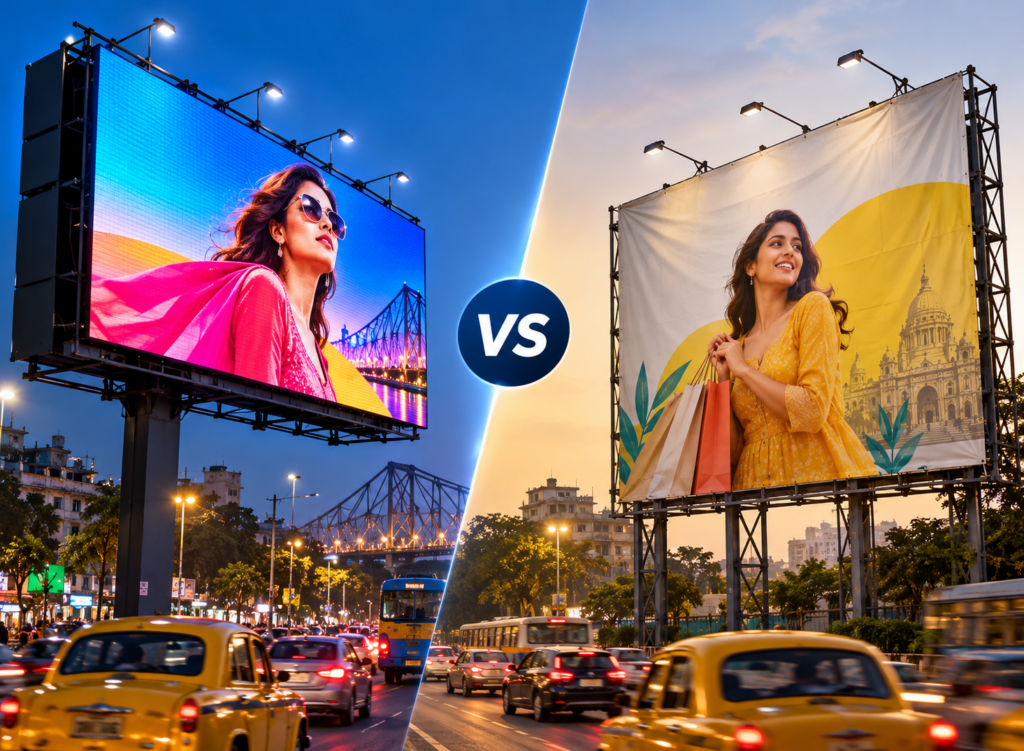
Shop owners in Kolkata ask us the same thing almost every week. Why pay for a screen slot every month when a printed flex costs once and stays up for a year?
Short answer first. Digital hoarding advertising pays off when your message changes often, your site sits at a busy junction, or you want different ads at different hours. A printed flex pays off when you need one steady message at a fixed spot and the budget is tight. Most businesses don’t have to pick one forever. They need to know which format suits each location.
What Digital Hoarding Advertising Means, and How a Flex Hoarding Differs
A flex hoarding is a large print on PVC or vinyl banner material, stretched across a metal frame and lit from the front or back. It’s what most people picture when they think of a billboard. You design it once, print it, mount it, and it says the same thing until someone takes it down.
Digital hoarding advertising replaces the print with an LED screen. Ads play in a loop, a few seconds each, and new content goes up through software instead of a ladder. It belongs to the wider family of digital signage, the same technology you see in malls, airports and metro stations.
One difference people miss. On a flex, the whole face belongs to you. On a shared LED screen, you’re one of several brands taking turns.
Outdoor Hoarding Advertising Costs, Compared Fairly
Prices swing a lot by site, size and duration, so it’s more useful to look at what actually drives the bill.
With a printed flex, you pay for:
- the print (size, plus frontlit or backlit flex grade)
- frame fabrication and mounting
- monthly site rent, which depends on the road and its traffic
- electricity, if it’s backlit
- a full reprint every time the offer, price or phone number changes
With a digital screen, the cost comes mostly from slot length and how often your ad plays per hour. Evening peak bands cost more than mid-afternoon ones, and booking several screens adds up quickly. Content production matters too, especially for motion graphics.
Where a flex quietly loses money
The print is cheap. The reprints aren’t. A café that changes its offer every fortnight ends up paying for printing and mounting again and again.
Then there’s the weather. Kolkata’s summer sun fades reds and yellows within months, and one strong Kalbaishakhi storm can rip a loosely tied flex off its frame overnight.
Where a digital screen costs more than it returns
If your ad runs for eight seconds in a loop shared with ten advertisers, a commuter stuck at a signal might see it once. Maybe. Digital hoarding advertising also needs creative made for screens. A flex design dropped onto an LED panel often looks washed out or cluttered, and people simply scroll past it with their eyes.
Digital vs Flex Outdoor Hoarding at a Glance
Factor | Printed flex hoarding | Digital hoarding advertising |
Upfront spend | Low | Higher, paid per slot or month |
Changing the message | Reprint and remount | Upload a new file, often same day |
Night visibility | Needs backlighting | Bright by default |
Exclusivity | Entire face is yours | Shared loop with other brands |
Weather wear | Fades and tears | Sealed screen, needs servicing |
Best suited to | One fixed message | Frequent offers, timed campaigns |
Which One Pays Off for Your Type of Business
A few patterns show up again and again in our projects.
- Restaurants and retail stores running weekly offers usually get more from digital hoarding advertising, since changing the creative costs nothing extra.
- Real estate launches. A screen works well for the first few months, while booking offers and site-visit dates keep shifting.
- Clinics, coaching centres and hardware shops rarely change their message, so a flex or one of our glow signboards right above the entrance does the job for far less.
- Cinemas and event organisers, whose campaigns last days rather than months, almost always come out ahead on a screen.
Our own rule of thumb is simple. If the hoarding is more than a kilometre from your shop and the offer changes more than once a month, go digital. If it’s on your own building and says the same thing all year, print it.
How to Design Creative Hoardings People Actually Read
A weak design fails on either format. A driver gives any outdoor hoarding two or three seconds at best, so a few rules apply to both:
- Keep the headline under eight words.
- Make the phone number or location the second-biggest element on the board.
- Pick strong contrast. Dark text on pale yellow beats grey on white every single time.
- Use one image, not four.
Screens need one more rule. Motion should catch the eye, not tell a story, because nobody watches a 15-second ad at a traffic light. Put the main message on the very first frame.
Honestly, the best creative hoardings we’ve produced were the plainest ones. Brand name, one benefit, one number.
A Mixed Plan Often Works Better Than Choosing One
Plenty of our clients split the budget. They keep a durable flex or acrylic sign boards at the store itself, where the message stays fixed, and book digital hoarding advertising at one or two busy crossings nearby for seasonal pushes. During Durga Puja, a screen at a crowded junction lets a saree store switch its creative from Panchami to Dashami without a single reprint.
It also lets you test properly. Run the same offer on both formats for a month, track enquiries through separate phone numbers or coupon codes, and you’ll see which one earns its keep at that spot.
Planning outdoor hoarding advertising across more than one site? Our work on outdoor signages Kolkata covers site selection, fabrication and installation, so you aren’t juggling three vendors for one board.
Your Next Step
Before you book any slot or print any flex, send Shree Shyam Signages a photo of the location and tell us what you want to promote. We’ll tell you whether a flex, a screen or a mix makes more sense for that spot, along with the cost factors involved. A WhatsApp message with the site photo is the quickest way to start.
FAQs
Is digital hoarding advertising worth it for a small business?
It can be, if you run frequent offers and the screen sits close to your customers. For one fixed message, a flex usually gives better value.
How long does a printed flex hoarding last outdoors?
Usually six months to a year in Kolkata conditions. Flex grade, sun exposure and how firmly it’s tied to the frame all affect this.
Can I change my ad on a digital hoarding whenever I want?
Mostly, yes. Operators often upload new creative within a day, though some charge for changes or ask for files a few days in advance, so check the contract.
What size works best for creative hoardings near a shop?
That depends on viewing distance. A board read from across the road needs bigger lettering than one seen from the footpath. Share the distance with us and we’ll suggest dimensions.
Do LED hoardings need permission in Kolkata?
Yes. Most outdoor hoarding installations, printed or digital, need approval from the local civic body, such as the Kolkata Municipal Corporation within city limits. The site owner or agency normally handles the paperwork.
Which gets more attention at night, flex or digital?
Digital, almost always. A front-lit flex depends on its lamps working, while an LED screen is bright on its own.