
Factory Sign Boards Guide From the Main Gate to the Shop Floor
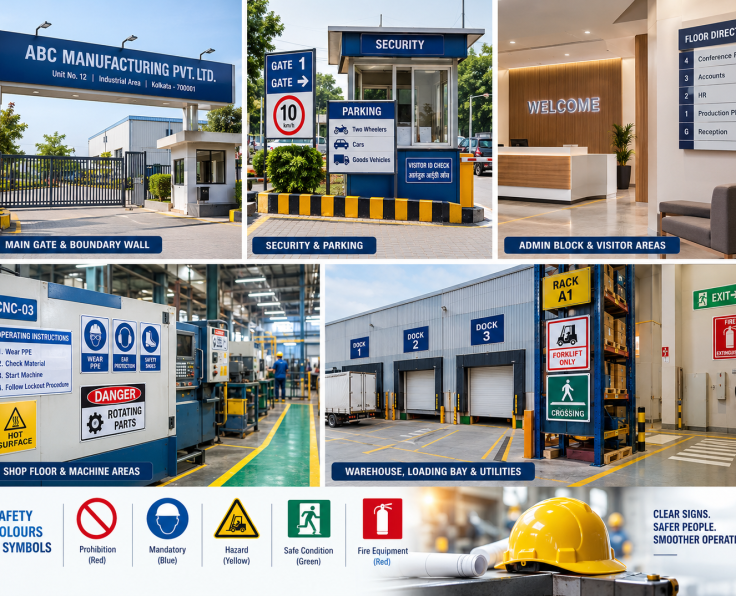
A truck driver at your gate, an auditor in your admin block and a new helper on his first shift all need the same thing from you. Signs they can read in two seconds. Good factory sign boards cover five zones of a plant: the main gate, security and parking, the admin block, the shop floor and the warehouse. Each zone needs its own message, material and letter size.
Most plants spend well on the gate and treat the rest of their factory sign boards as an afterthought. That’s backwards. The shop floor is where a missing warning costs the most, and DGFASLI data for 2023 records 1,090 fatal and 2,949 non-fatal injuries across roughly 3.54 lakh registered factories in India. Those are only the cases that got reported.
What are factory sign boards?
Factory sign boards are the fixed boards, plates and floor markings that identify a manufacturing unit, guide people around it and warn them about hazards inside. They fall into three groups. Identity signs include the company name board and unit number. Wayfinding signs cover gate numbers, department directories and dock markers. Then there are industrial signs, which carry safety, PPE and compliance messages.
Factory sign boards checklist, zone by zone
Main gate and boundary wall
This is the factory sign transporters hunt for at 2 am and visitors match against Google Maps. Put the company name, plot or unit number and address on it. If trucks arrive after dark, a front lit board on the boundary wall keeps the name readable without floodlighting the whole frontage. Mount it high enough to clear parked lorries, usually 2.5 to 3 metres above road level.
Security cabin and parking
- Separate entry and exit gate numbers
- An internal speed limit board, commonly 10 or 15 km/h
- Marked parking for two-wheelers, cars and goods vehicles
- Visitor ID-check instructions in English and the local language
Admin block and visitor areas
Buyers and auditors form their opinion here. A reception logo, a floor-wise directory and room plates do most of the work. A sealed LED neon logo in the visitor lounge works well too, and it’s the same build we use for neon signs in kolkata cafés and showrooms.
Shop floor and machine areas
This is where industrial signs earn their money. Every machine needs an ID plate and a short operating or lockout instruction at eye level, roughly 1.5 metres from the floor. Add PPE boards at each section entry, warnings beside hot surfaces, rotating parts and electrical panels, and painted walkway lines.
One mistake we see again and again is the instruction plate bolted above the machine. An operator bent over a lathe never looks up.
Warehouse, loading bay and utilities
Number every dock door in digits a driver can read from his cab. Mark rack rows, forklift-only lanes and pedestrian crossings. The DG set room, boiler house, compressor room and chemical store each need a restricted-entry factory sign. Exit routes and fire extinguisher markers should be photoluminescent, so they still show when the power trips.
What safety colours should industrial signs follow?
In India, industrial signs follow IS 9457, which lines up with the international ISO 7010 system. Colour and shape deliver the message before anyone reads a word:
- Red circle with a diagonal bar for prohibition, such as no smoking or no entry
- Blue circle for a mandatory action, like wearing ear protection
- Yellow triangle with a black border for hazards, including high voltage or forklift traffic
- Green rectangle for safe conditions (emergency exit, first aid, assembly point)
- Red square to show where fire equipment is kept
Factory inspectors look for these during visits, under the Factories Act, 1948 and its successor, the Occupational Safety, Health and Working Conditions Code, 2020. Pictograms matter even more when one shift speaks Hindi, Bengali, Odia and English. Worldwide, ILO estimates put non-fatal occupational injuries at over 395 million a year, and a clear symbol is one of the cheapest controls any plant can add.
How to choose an industrial font for factory signs
The right industrial font is plain, bold and slightly condensed. Decorative scripts and thin serif faces fall apart at 20 metres, especially on reflective sheet.
Faces that hold up well on factory sign boards:
- DIN 1451, the German road-sign standard and our safest default
- Helvetica Bold or Arial Bold for directories and room plates
- Stencil lettering for markings sprayed on tanks, chimneys and shed walls
- Roboto Condensed when long department names must fit narrow boards
Letter height decides readability more than the industrial font itself. A working rule many sign makers use is about 25 mm of capital height for every 3 metres of viewing distance. So a gate name read from 30 metres needs letters near 250 mm tall, while a machine label read at arm’s length can sit at 10 to 15 mm.
Keep the contrast high, such as black on yellow or white on blue. Choose the industrial font before you choose the material; changing it after fabrication means remaking the board.
Which materials last on factory sign boards?
Humidity, diesel fumes, monsoon rain and the odd forklift knock will finish a cheap board in under two years. Match the material to where the sign lives:
- Aluminium composite panel with UV-printed or vinyl graphics for gate boards, directories and outdoor wayfinding
- Aluminium sheet with retro-reflective vinyl for parking, traffic and dock signs that headlights must pick up
- Etched stainless steel plates near oil, coolant and heat
- Photoluminescent PVC for exit routes and fire points
- Floor-grade vinyl tape or epoxy paint for walkways and forklift lanes
The failure we’re called in to fix most often is a flex factory sign stretched over a mild steel frame at the gate. It looks fine for one season. Then the frame rusts and the print sags, right in front of every visitor.
FAQs
Are factory sign boards mandatory in India?
Safety signage is. Hazard warnings, emergency exits and fire equipment markers are expected under factory safety law and checked during inspections. Name boards and wayfinding signs usually aren’t legally required.
What size should a factory name board be?
Work backwards from the reading distance. Most gate boards for small and mid-size units land between 8 × 3 feet and 12 × 4 feet, with letters around 200 to 300 mm tall.
Which industrial font is easiest to read from far away?
DIN 1451 Bold. It was built for road signs, which is the same job.
How long do industrial signs last outdoors?
A well-made ACP or aluminium board with UV-resistant print should give you five years or more. Flex on an iron frame rarely survives two monsoons.
Getting your plant’s signs right the first time
Walk your plant once with this checklist, gate first. Note every spot where someone had to ask for directions, or squint at a faded board. That list is your signage brief.
Shree Shyam Signages designs, fabricates and installs factory sign boards for manufacturing units in Kolkata and beyond. Send us your plant layout or site photos and we’ll quote the full set.