
Lollipop Board Design Tips on Sizes, Materials, Lighting and Layouts That Get Noticed
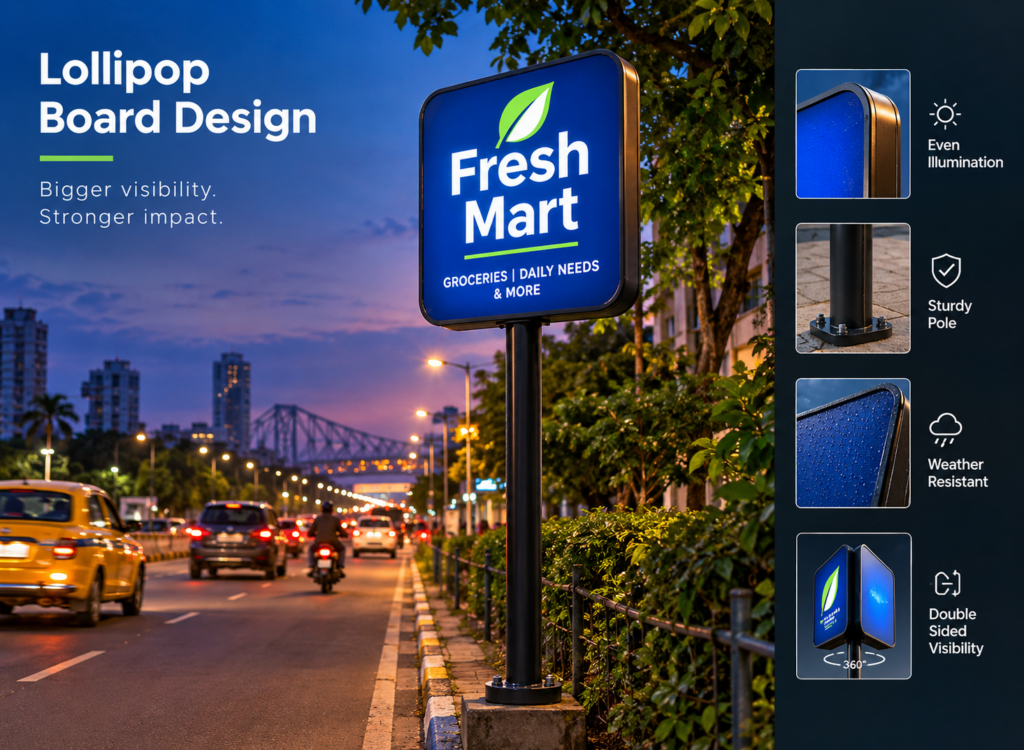
Drive down EM Bypass at 8 pm and count how many roadside signs you can actually read. Most blur past. The problem is rarely the budget. It’s the lollipop board design: letters too small for the distance, a face that goes dark after sunset, or a pole planted right behind a tree.
A lollipop board is a sign head (round, square or rectangular) mounted on a single pole, usually along footpaths, medians and the entrances of malls, hospitals and housing projects. It sits at eye level and faces traffic from both directions, which a rooftop hoarding can’t do. Below is what we check before fabricating one.
What Makes a Lollipop Display Board Different
A lollipop display board belongs to the same family of street furniture as bus shelters and kiosks. People see it up close, but only for a moment. A motorist at 40 km/h passes a roadside sign in roughly four or five seconds.
So you’re designing for a glance, not a read. Every lollipop board design decision that follows comes back to that one fact.
Picking the Right Lollipop Board Size
Size depends on road width and how far away people will be when they first spot the sign. These are the sizes we make most often:
- 2 x 3 ft for society gates, clinic entrances and lane-level direction signs
- 3 x 4 ft, the everyday choice for shops on a main road
- 4 x 6 ft for highways, wide medians and real estate site launches
- Round heads of 3 to 4 ft diameter, which suit brands whose logo is already circular
A simple sign-industry rule helps here. Allow about one inch of letter height for every 10 feet of viewing distance. If you want the name readable from 80 feet, the letters need to be around 8 inches tall. On a 3 x 4 ft head, that leaves room for one line of text and a logo. Nothing more.
Single-sided or double-sided?
Go double-sided on any two-way road. A single face only makes sense when the board stands against a wall or boundary. The extra fabrication cost is small compared to doubling your visibility.
Pole height matters too. Keep 8 to 10 ft of clear space under the head so pedestrians, umbrellas and parked autos don’t block the view.
Materials That Survive Kolkata Weather
Monsoon here runs from June to September, the air stays humid for most of the year, and road dust settles on everything. We’ve seen cheap boards rust through at the pole base within two rainy seasons.
The pole should be MS pipe with primer and powder coating, or GI for better rust resistance, set in a proper concrete foundation. For the frame, MS angle or aluminium section works.
The face is where most of the choice lies. Printed flex is the cheapest but starts fading in about 18 months. An aluminium composite panel with raised acrylic letters looks sharper and lasts longer. For backlit boards, a translucent sheet of acrylic (PMMA) spreads light more evenly than flex does.
One mistake we see constantly is a sign box with no gasket or drip edge. Rainwater seeps in, and the lights die by August.
Lighting a Lollipop Glow Sign Board or LED Board
Half your audience passes after dark. An unlit board effectively works part-time.
Lollipop glow sign board
This is a backlit box with a flex or acrylic face and LED modules inside (older boards used tube lights). It gives an even glow, uses little power and is easy to repair. Most of our glow signboards for retail shops follow this build.
Lollipop LED board
The term means two different things in the market, so clarify it before you take quotes. Some vendors call any backlit sign that uses light-emitting diodes a lollipop LED board. Others mean a digital LED screen that rotates images or short videos.
A digital screen lets you change offers weekly and even sell ad slots. It also needs a controller, a stable power supply and an outdoor rating of at least IP65 under the IP code. Ask for night dimming, too, because a full-brightness screen at 11 pm glares and annoys residents.
Our honest take? For a single shop, a well-built lollipop glow sign board is enough. Digital pays off when the content changes often or the board earns rent from advertisers.
Layout Tips for Lollipop Advertising Boards
Good lollipop advertising boards say less than you’d expect. Keep the copy under seven words per face. Brand name, one benefit, and a direction cue like “200 m ahead, left” will outperform a phone number, which nobody remembers at speed.
Other rules worth following:
- Use a dark background with white or yellow letters for backlit faces. White backgrounds glare at night.
- Place the logo in the top third and leave a margin of about 10% around the edges.
- Pick heavy sans-serif fonts. Script fonts become unreadable at 40 feet.
- Match colours to your shopfront so people connect the sign with the store.
Placement can make or break good lollipop board design. Walk the spot before finalising it. Check for trees, electric poles and existing hoardings in the sightline, and confirm permission from the municipal corporation or whichever authority owns the land.
What Affects the Cost of a Lollipop Board
Prices vary widely, so look at what drives them rather than a single figure:
- Head size and whether it’s single or double-sided
- Face material (flex, ACP or acrylic)
- Lighting type, with digital screens costing the most
- Pole height, thickness and foundation depth
- Installation, wiring and local permission fees
Where to Start
If your board sits on a two-way road and your offer rarely changes, choose a double-sided backlit board with an acrylic face. If you plan to rotate promotions or rent the space out, budget for a digital screen instead.
Shree Shyam Signages designs, fabricates and installs lollipop boards and other outdoor signages Kolkata businesses rely on. Send us a photo of your site and the road width on WhatsApp, and we’ll share a free mockup before you commit.
Frequently Asked Questions
What is a lollipop board used for?
Roadside branding and directions. Shops, hospitals, schools and real estate projects use them to catch traffic at eye level.
What is the standard lollipop board size?
There isn’t one fixed standard. A 3 x 4 ft head on a 10 ft pole is the most common for shops, while highways usually need 4 x 6 ft.
Is a lollipop LED board better than a lollipop glow sign board?
Not always. A digital LED board is better for changing content, but a glow sign board costs less, uses less power and is simpler to maintain.
Do I need permission to install a lollipop display board in Kolkata?
Usually, yes. Boards on public footpaths or medians need approval from the municipal body or the land-owning authority, and rules differ by area.
How long does a lollipop board last?
A powder-coated pole with an acrylic or ACP face can last 5 to 7 years with basic upkeep. Flex faces need replacing sooner.
Can lollipop advertising boards be double-sided?
Yes, and on two-way roads they should be.