
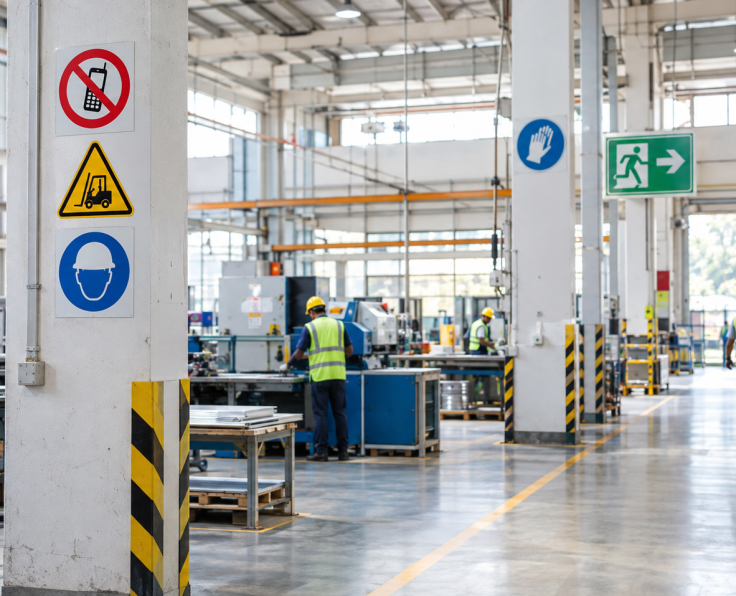
A fire extinguisher hidden behind a stack of cartons. A “Wear Helmet” board so faded that nobody reads it anymore. We see both on almost every factory visit around Kolkata.
Safety signs in the workplace are colour-coded boards and symbols that warn people about hazards, tell them what to do and show them the way out in an emergency. In India, their design follows the IS 9457 standard, and the legal duty to put them up comes from the Occupational Safety, Health and Working Conditions Code, 2020.
The stakes are real. The International Labour Organization estimates that close to 3 million workers die every year from work-related accidents and diseases. A sign can’t prevent all of that. But a clear one, in the right spot, does stop the worker who was about to walk into a live panel room without gloves.
What are safety signs, in plain words?
So, what are safety signs? They’re visual instructions that combine a colour, a shape and a pictogram so the message lands in under a second, even for someone who can’t read the text printed below it. That matters on Indian shop floors, where one unit might employ people who speak Bengali, Hindi and Odia.
The international system behind them is ISO 7010. India’s matching standard, IS 9457, is published by the Bureau of Indian Standards. You can read more about the general concept on Wikipedia’s safety sign page.
Safety sign colours and what each one tells you
Colour | Shape | Meaning | Common examples |
Red | Circle with diagonal bar | Prohibition (don’t do this) | No smoking, no entry |
Yellow | Triangle, black border | Warning (hazard ahead) | High voltage, forklift area |
Blue | Solid circle | Mandatory (you must do this) | Wear helmet, wear ear protection |
Green | Square or rectangle | Safe condition | Emergency exit, first aid |
Red | Square | Fire equipment location | Extinguisher, fire alarm point |
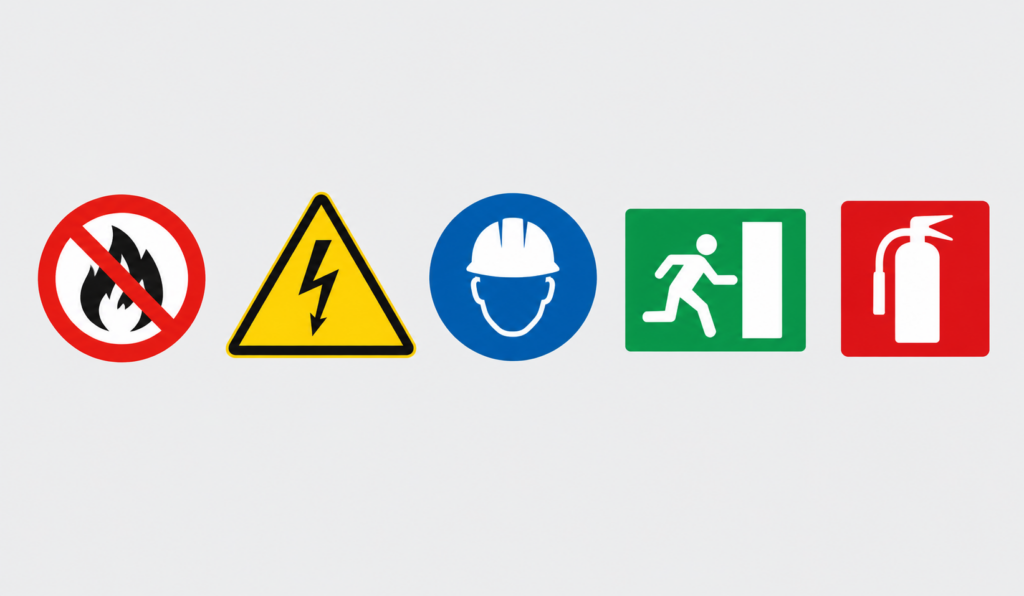
One mistake we keep running into is a “No Smoking” board printed in the company’s brand colours because someone thought red looked harsh. Don’t do it. On a safety sign, the colour is the message.
Five types of safety signages in workplace settings
Most safety signages in workplace environments fall into five groups:
- Prohibition signs. Red circle, diagonal bar. No smoking, no open flames, no unauthorised entry.
- Warning signs sit on a yellow triangle and flag hazards like electricity, slippery floors, corrosive chemicals or moving vehicles.
- Mandatory signs use a blue disc. Helmets, safety shoes, goggles.
- Safe condition signs are green and point people to exits, eye-wash stations, first aid boxes and assembly points.
- Fire equipment signs mark extinguishers, hose reels and call points. India covers these separately under IS 12349.
Safety signs and meanings you’ll see most often
Symbol | Category | What it means |
Lightning bolt | Warning | Electrical hazard |
Flame | Warning | Flammable material |
Skull and crossbones | Warning | Toxic substance |
Hard hat | Mandatory | Head protection required |
Crossed-out cigarette | Prohibition | No smoking |
Running figure and door | Safe condition | Emergency exit |
White cross on green | Safe condition | First aid |
Learning these safety signs and meanings takes about ten minutes. We’d suggest putting this table on the induction sheet for every new hire, including contract labour.
Indian rules for safety signs in the workplace
India’s labour law changed in a big way on 21 November 2025. That’s when the OSH Code, 2020 came into force, replacing 13 older central labour laws, the Factories Act, 1948 among them. The Code puts the responsibility on employers to identify hazards and warn workers about them, and in practice that means proper signage. Updates and notifications are published by the Ministry of Labour and Employment.
Here’s what you should be following right now:
- IS 9457 (Part 1) for the colours, shapes and layout of safety signs in the workplace and public areas.
- IS 12349 for fire protection signs.
- The National Building Code of India, 2016 (Part 4, Fire and Life Safety), which expects exit routes to be clearly marked and visible even during a power failure.
- Your state’s own OSH rules, plus the fire department’s checklist when you renew a fire licence.
For technical guidance on factory safety, the Directorate General Factory Advice Service and Labour Institutes (DGFASLI) is the government body worth bookmarking. Rules at state level are still being rolled out, so check with your safety officer before an inspection.
Getting placement and materials right
A compliant sign in the wrong place is useless. We usually mount boards between 1.5 and 2 metres from the floor, at the point where a person needs the information, not three metres after it. A “Wear Ear Protection” sign belongs at the door of the compressor room, not inside it.
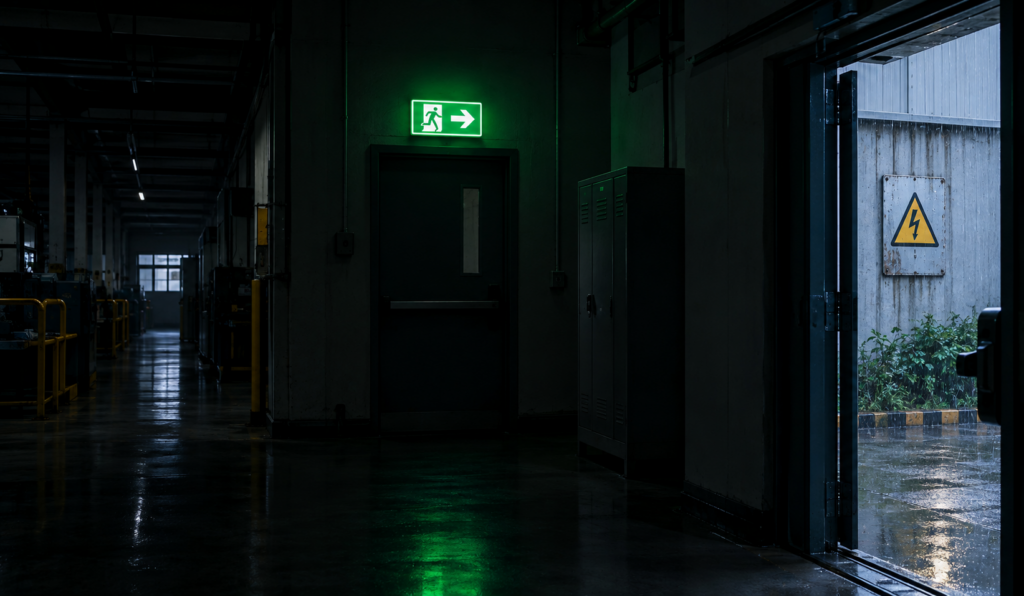
Material matters just as much, especially in our climate.
Area | What works well | Why |
Outdoor yards, loading bays | ACP boards | Won’t rust or warp in monsoon |
Corridors, stairwells | Photoluminescent or LED exit signs | Visible during power cuts |
Offices, receptions | Acrylic or glow boards | Neat finish, easy to read |
Control rooms, large plants | Digital screens | Messages can be updated daily |
For outdoor use, we print warning boards on aluminium composite panel sheets because they survive a full Kolkata monsoon without peeling. As an LED signage company in Kolkata, we also fit exit boards with battery backup, since an exit sign that goes dark during a blackout fails at the one moment it’s needed.
Showrooms and corporate offices often want safety information to match the interiors, and stylish glow signboards for commercial spaces can carry exit and assembly point details without looking like an afterthought. Bigger plants with a control room sometimes go a step further and rotate safety alerts on screens installed by video wall manufacturers, right beside the CCTV feed.
A ten-minute signage audit you can do this week
Walk your floor with a phone camera. Photograph every sign. Then ask:
- Is it readable from at least 5 metres away?
- Has the colour faded, especially on boards facing west?
- Is anything blocking it, like racks, plants or a parked trolley?
- Does every extinguisher have a sign above it?
Faded or missing boards are the most common fail point in inspections we’ve seen. If your audit turns up more than a handful of gaps, Shree Shyam Signages can make a full set of IS 9457 compliant boards for your site. Call us with your floor plan and we’ll suggest what goes where.
Frequently Asked Questions
What are the four main types of safety signs?
Prohibition (red), warning (yellow), mandatory (blue) and safe condition (green). Fire equipment signs are often counted as a fifth type.
Are safety signs compulsory in Indian offices, or only in factories?
They apply to offices too. Every commercial building needs exit and fire equipment signage under the National Building Code and local fire rules, even if the OSH Code’s factory provisions don’t cover it.
What colour is a mandatory safety sign?
Blue, on a round shape.
How often should workplace safety signs be replaced?
There’s no fixed date. Replace a board as soon as it fades, cracks or becomes hard to read. Outdoor signs in eastern India usually need checking after every monsoon.
Do exit signs have to glow in the dark?
They need to remain visible during a power cut. Photoluminescent boards or LED signs with battery backup both meet that requirement.
Is IS 9457 the same as ISO 7010?
They’re closely aligned. IS 9457 sets the design rules for colours and shapes, while ISO 7010 provides the registered set of standard pictograms that most Indian manufacturers follow.