
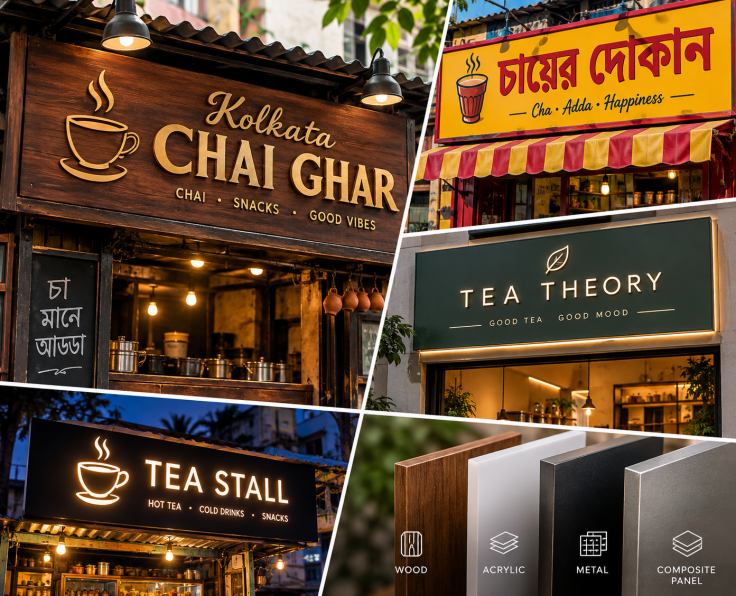
Walk down almost any street in Kolkata and you’ll spot a tea stall before you spot anything else on the block. That’s rarely an accident. A well-made tea shop name board does the same job a good storefront does for a big brand: it stops people mid-stride and tells them exactly what’s waiting for them. Whether you’re setting up your first stall or giving an old shop a fresh face in 2026, the board above your counter is one of the cheapest, highest-impact investments you can make.
This guide walks through the design styles, materials and placement choices that actually work for tea businesses right now, along with a few things most shop owners only learn after their first board fades, cracks, or simply gets ignored.
Why a Tea Stall Board Design Deserves More Thought Than It Gets
Most tea sellers treat their board as an afterthought, something a local painter knocks out in an afternoon. That’s understandable when margins are thin, but it’s also why so many stalls end up looking identical. A thoughtful tea stall board does three things a plain painted plank never will:
- Makes the shop recognisable from a distance, even in a crowded market
- Communicates the vibe of the place before a customer walks up, whether that’s a heritage chai wallah, a quick-service kiosk, or a modern café-style counter
- Holds up through Kolkata’s humidity, monsoon rain and constant sun without needing a repaint every few months
Signage, in the broadest sense, exists to communicate a message at a glance, and a tea stall’s board is doing exactly that job under some of the toughest everyday conditions a sign can face.
Tea Shop Name Board Design Ideas for 2026
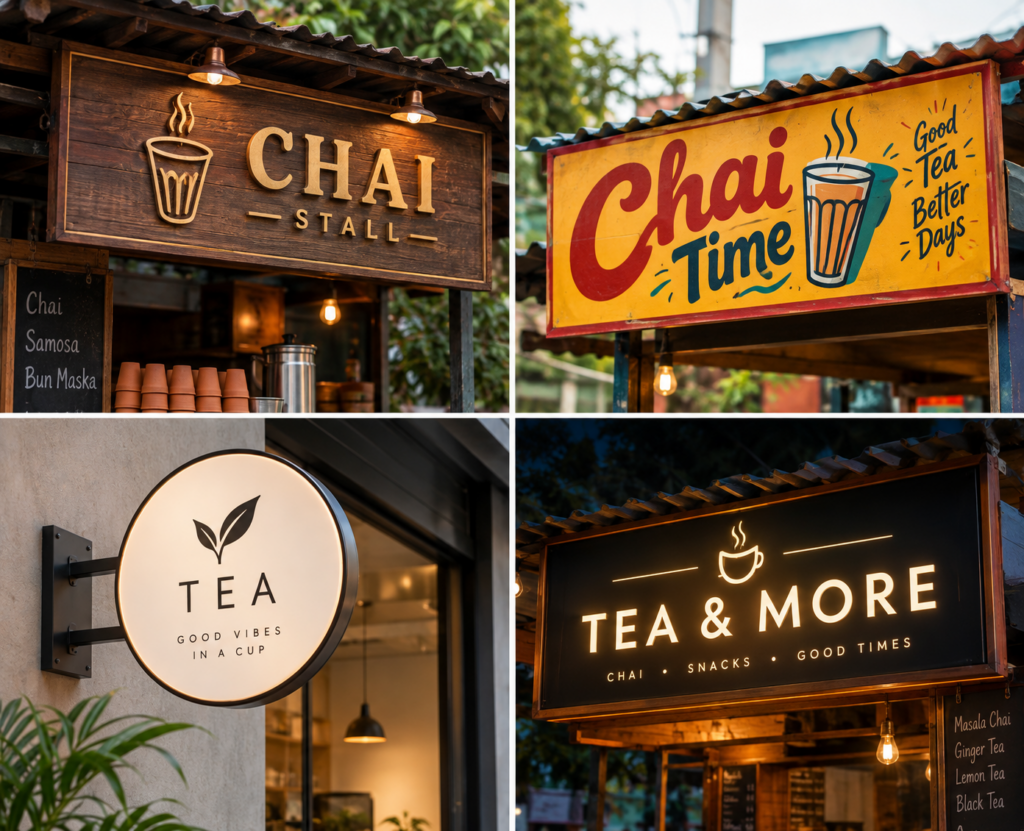
Design trends for small food and beverage boards have shifted quite a bit over the past couple of years. Here’s what’s actually working for tea businesses this year.
1. Classic Wooden Tea Stall Name Board Designs
There’s a reason the old-school wooden board with hand-painted or engraved lettering hasn’t gone out of style. A tea stall name board in natural or dark-stained wood, paired with brass or copper-toned lettering, instantly signals authenticity, which matters a lot for stalls leaning into the “traditional chai” positioning. India’s tea-drinking habits run deep; the roadside stall has been part of everyday Indian tea culture for generations, and a wooden board plays right into that nostalgia.
2. Bold, Colorful Boards for Street-Side Tea Stalls
Not every stall wants heritage charm. Plenty of newer setups go the opposite direction: mustard yellows, deep reds, and terracotta tones with playful hand-lettered fonts. These boards are built to grab attention in five seconds flat, which is often all you get from someone walking past a busy junction.
3. Minimal Modern Tea Shop Board Design
For stalls positioning themselves closer to a café than a roadside kiosk, a clean tea shop board design with a simple wordmark, muted background, and generous white space reads as more premium. This style pairs well with acrylic or metal boards rather than painted wood.
4. Illuminated Boards for Evening Footfall
Tea stalls often do a good chunk of business after dark: evening snacks, late tea runs, students on their way home. A board that’s easy to read at night keeps working for you long after the sun goes down. If evening visibility matters for your location, it’s worth talking to an LED signage company in Kolkata about backlit or edge-lit options rather than relying on a nearby streetlight.
Choosing the Right Material for Your Board
The design only lasts as long as the material behind it. A few common options:
Wood: warm and traditional, but needs sealing and occasional maintenance against moisture.
Acrylic: lightweight, weather-resistant, and takes vibrant colour printing well, making it a solid pick for the bold, colourful style above.
Metal sheet: sturdy and long-lasting, though it can heat up under direct sun.
Composite panels: an increasingly popular middle ground. An aluminium composite panel gives you a flat, professional finish that resists warping and fading far better than plain wood or plastic, while staying lighter than solid metal.
Where and How to Place Your Tea Shop Name Board
Design and material only pay off if people actually see the board. A few things worth checking before installation:
- Height and angle relative to normal eye level for people walking or driving past
- Whether trees, parked vehicles, or neighbouring shop signs block the view at peak hours
- Sun glare at different times of day, which can wash out even a well-designed board
Placement is really a question of out-of-home advertising fundamentals scaled down to a single storefront, since the same principles that guide billboard positioning apply to a tea stall board on a busy corner. For stalls on wider roads or with more space to work with, exploring options with experienced outdoor signages Kolkata providers can help you figure out sizing and placement that suits the specific street. Larger tea chains or stalls near highways sometimes go a step further with tall, freestanding structures, something worth discussing with Pylon Sign Board Manufacturers if visibility from a distance is the priority.
Getting the Branding Right
Beyond the material and the mounting, a few small choices make a bigger difference than most owners expect:
- Keep the shop name in one clear font rather than mixing three or four styles
- Use no more than two main colours so the board stays readable from a moving vehicle
- Add a short tagline only if there’s room without crowding the name itself
- Match the board’s colour scheme to your cups, packaging or awning for a consistent look
A Few Notes From Years of Making These Boards
Having worked on signage for food stalls, cafés and retail shops across Kolkata for years, a pattern shows up again and again: owners who invest a bit more upfront in weatherproof material and clear, legible lettering end up replacing their board far less often, and their stall tends to be the one people remember when giving directions. A board that says “second tea stall past the big banyan tree” is doing its job. One with a genuinely distinct tea shop name board design does that job without needing a landmark at all.
Frequently Asked Questions
What size should a tea stall name board be?
Most small stalls do well with a board between 3 to 6 feet wide, though the right size depends on how far away it needs to be readable from and how much frontage space you have.
How much does a tea shop board design typically cost?
Cost depends mainly on material, size and lighting. Acrylic and printed boards tend to sit at the lower end, while composite panels and illuminated boards cost more upfront but usually last longer.
Is LED lighting worth it for a small tea stall?
If your stall does meaningful business in the evening or at night, yes. A lit board keeps you visible long after natural light fades, which a plain painted board can’t do.
What’s the most durable material for an outdoor tea stall board?
Aluminium composite panels generally hold up best against Kolkata’s heat, humidity and monsoon rain, followed by acrylic. Untreated wood is the least weather-resistant of the common options.
Should the board include a phone number or just the shop name?
For a walk-in tea stall, the name and a simple visual identity usually matter more than contact details. A phone number is more useful if you also take bulk or catering orders.
How often should a tea stall board be replaced or repainted?
A well-made board in a durable material can often go 3 to 5 years before needing a refresh, while painted wood boards may need touch-ups every year or so depending on sun and rain exposure.