Kiosk Manufacturers in India and How to Choose the Right One (2026 Buyer's Guide)
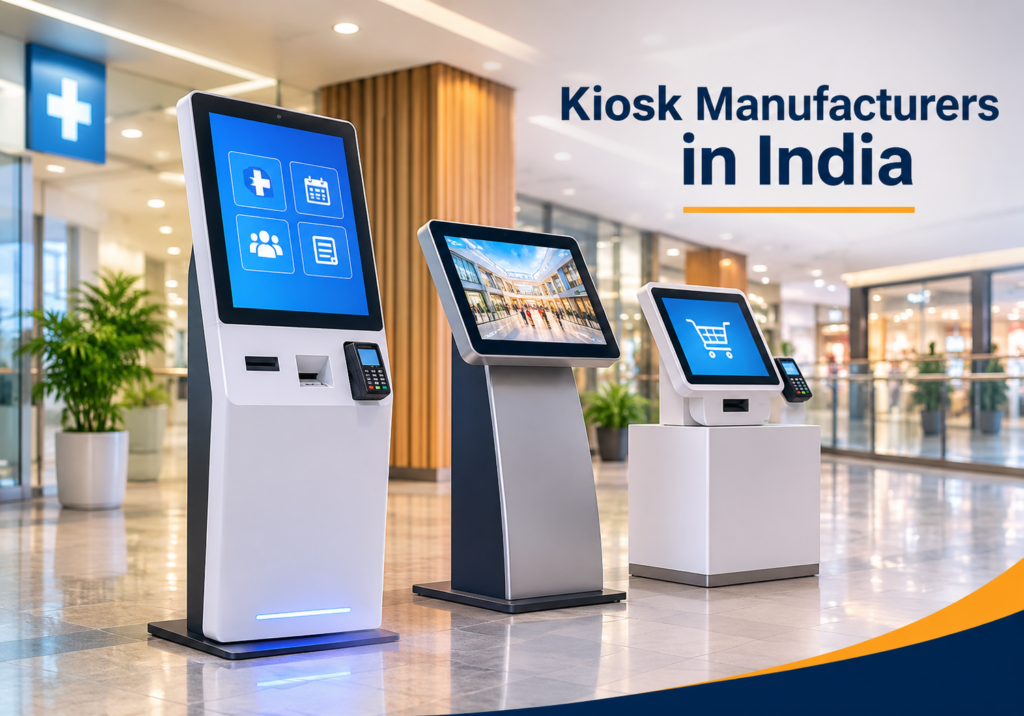
The best kiosk manufacturers in India build for the spot where your unit will actually stand, not for the photo in their catalogue. A hospital lobby, a mall atrium and a petrol pump forecourt each need a different cabinet, a different screen and a different service plan. Buy on price alone and there’s a fair chance you’ll be chasing a replacement touch panel within a year.
So what should you check? This guide covers the kiosk display screen, the cabinet, the software, the peripherals and the after-sales terms. It’s written for facility heads, store owners and procurement teams who’d rather ask the awkward questions before the purchase order goes out.
Planning a kiosk rollout for a store, clinic or office? Get in touch with our team with your site details and we’ll suggest a build that fits the space and the budget.
What does a kiosk manufacturer in India actually make?
A kiosk manufacturer designs and assembles the whole self-service unit. That means the metal enclosure, the kiosk display, the touch layer, the internal PC or Android board, and add-ons like receipt printers, card readers and QR scanners. Many also customise the software that runs on it.
Kiosk suppliers in India often work differently. Plenty of them resell imported or white-labelled units and have little control over how the box is built.
That gap shows up when something breaks. A maker can usually pull a spare from its own workshop. A reseller has to wait on someone else’s stock, and someone else’s timeline.
Common types of kiosk display units you’ll be offered
Before comparing vendors, get clear on which kind you need. Most quotes fall into one of these:
- Floor-standing touch kiosks for check-in, billing, token generation and visitor registration in hospitals, banks and government offices.
- Wall-mounted units, handy in clinics and corridors where floor space is tight.
- Tabletop kiosks for restaurant ordering counters.
- Outdoor kiosks with IP65-rated cabinets and high-brightness panels. They cost a lot more, so buy one only if the unit will genuinely face sun and rain.
- Wayfinding kiosks, which work best alongside physical way finding signages in malls, hospitals and campuses.
- Advertising kiosks with no touch at all.
That last group sits closer to digital signage than to self-service. If you want visitors to tap, search, pay or print, you’re shopping for interactive kiosks. If you only need to show content, a simple kiosk display or a wall of LED screens may do the job for less money.
How to choose the right kiosk manufacturers in India
Shortlist three or four makers, then put each one through the checks below. It takes a week at most, and it saves months of headaches.
Start with the kiosk display screen
Most of the cost, and most of the complaints, sit here. Ask for these details in writing:
- Brightness, measured in nits. Around 350 to 500 nits is normal indoors. A unit near a glass entrance or in open air usually needs 1,500 or more.
- Touch type. Projected capacitive touchscreen panels feel like a smartphone. Infrared frames cost less but can misread taps once dust collects on the bezel.
- Panel grade. Is it a commercial panel rated for long daily hours, or a consumer TV panel fitted inside a metal box?
- Size. A 32 or 43 inch kiosk display screen covers most lobby jobs; 55 inch suits ad-heavy setups.
One mistake we see again and again: a showroom picks a standard-brightness 43-inch screen for a glass-fronted entrance, and by noon nobody can read it. Ask for a demo in lighting like yours before you sign.
Look at the cabinet, not the brochure
Good enclosures use cold-rolled steel of roughly 1.2 to 1.5 mm, a proper powder coat, cooling fans and lockable service doors. In humid cities like Kolkata, Chennai or Mumbai, a poorly ventilated cabinet cooks the internal board within a couple of summers. Power is the other Indian reality. Ask whether they fit surge protection or recommend a UPS.
Check the software and integrations
Does the maker supply the software, or will you bring your own? Find out which operating system it runs, whether content can be updated remotely, and whether it locks into kiosk mode so users can’t wander off into settings. If the unit has to talk to your billing, hospital or queue system, get that integration confirmed before the order, not after delivery.
Peripherals and spares
Thermal printers, barcode scanners, card readers and cameras should come from brands with service centres in India. Imported parts with no local support turn a ten-minute fix into a three-week wait.
After-sales service and warranty
This is where kiosk suppliers in India differ the most. Ask four plain questions. Is the warranty on-site or return-to-base? What’s the response time in your city? Do they stock spare panels? What does the annual maintenance contract cost after year one?
Local manufacturing and paperwork
Units built under Make in India can matter if you’re bidding for government tenders with local-content preference. Also ask whether components carry Bureau of Indian Standards registration where it applies, and make sure you’ll get a proper GST invoice.
Red flags when comparing kiosk suppliers in India
Walk away, or at least slow down, if you notice any of these:
- No factory or workshop you can visit, even over a video call.
- A quote that doesn’t name the panel brand or the touch technology.
- The same cabinet offered for a hospital lobby and a bus stand.
- A warranty that covers the internal PC but leaves out the kiosk display screen.
- Pressure to pay in full upfront for a custom build.
What decides kiosk prices in 2026?
There’s no single price list, because five things move the number: screen size, brightness, touch type, peripherals and order quantity. A 32-inch indoor Android unit with no printer sits at the low end. A 55-inch outdoor unit with a thermal printer and card reader can cost several times as much.
Always ask for an itemised quote. Without one, you can’t compare two kiosk manufacturers in India like for like.
If the kiosk is part of a bigger retail fit-out, ordering it together with your POS signage and in-store displays from one vendor usually trims design and installation costs.
Making the final call
If a maker can show you the workshop, demo the screen in your lighting and put the service terms in writing, they belong on your shortlist. If they dodge any of those three, keep looking. Price matters, but a cheap unit that’s dark for two weeks every monsoon is the expensive one.
Shree Shyam Signages builds kiosks alongside its signage and display work, so the unit, the screen and the branding around it come from one team. Among kiosk manufacturers in India, that single point of contact is often what keeps a rollout on schedule.
Want a quick estimate? Message us on WhatsApp with your location, preferred screen size and the number of units, and we’ll send back options that suit the site.
Frequently asked questions
Who are the best kiosk manufacturers in India?
There’s no single best one. The right pick is the maker that fabricates in-house, uses commercial-grade panels and can send a technician to your city quickly.
How long does a kiosk display screen last?
Many commercial panels are rated for around 50,000 hours, which works out to several years of daily use. Heat, dust and power surges cut that short, so cooling and surge protection matter as much as the panel itself.
Can a kiosk work outdoors in an Indian summer?
Yes, if it’s built for it. You’ll need a high-brightness screen, an IP65 cabinet and active cooling. A standard indoor unit placed outside won’t last a season.
What’s the difference between a kiosk and digital signage?
A kiosk lets people interact with it. They tap, search, pay or print. Digital signage only shows content, like a menu board or an ad loop.
Do kiosks need an internet connection?
Not always. Offline kiosks can run token systems or catalogues locally, but you’ll need connectivity for payments, live data and remote content updates.
How long do kiosk suppliers in India take to deliver?
Standard models are often ready in a few weeks. Custom cabinets, branding or software integration take longer, so get the delivery date written into the order.